Research
Sit with the people doing the work, find what costs them time or money, and write it down as a numbered blueprint and a decisions log.
TechZap Labs · Product & R&D
We are the product and R&D arm of TechZap. We turn hard operational problems into software that runs in production — then we publish how we did it.
What we do
TechZap Solutions builds for clients. Zaptra builds brands and websites. Labs builds the platforms underneath them — products the group owns, runs and sells. We work in three modes, usually all at once.
Sit with the people doing the work, find what costs them time or money, and write it down as a numbered blueprint and a decisions log.
Design the domain model, the APIs and the interfaces. Java and Spring on the server, React on the client, tests against a real database.
Containers, CI/CD, TLS, backups, monitoring and on-call — plus the help centre and videos that keep support quiet.
Featured study · 01
Live since Sep 2026A ClientOS for a digital studio.
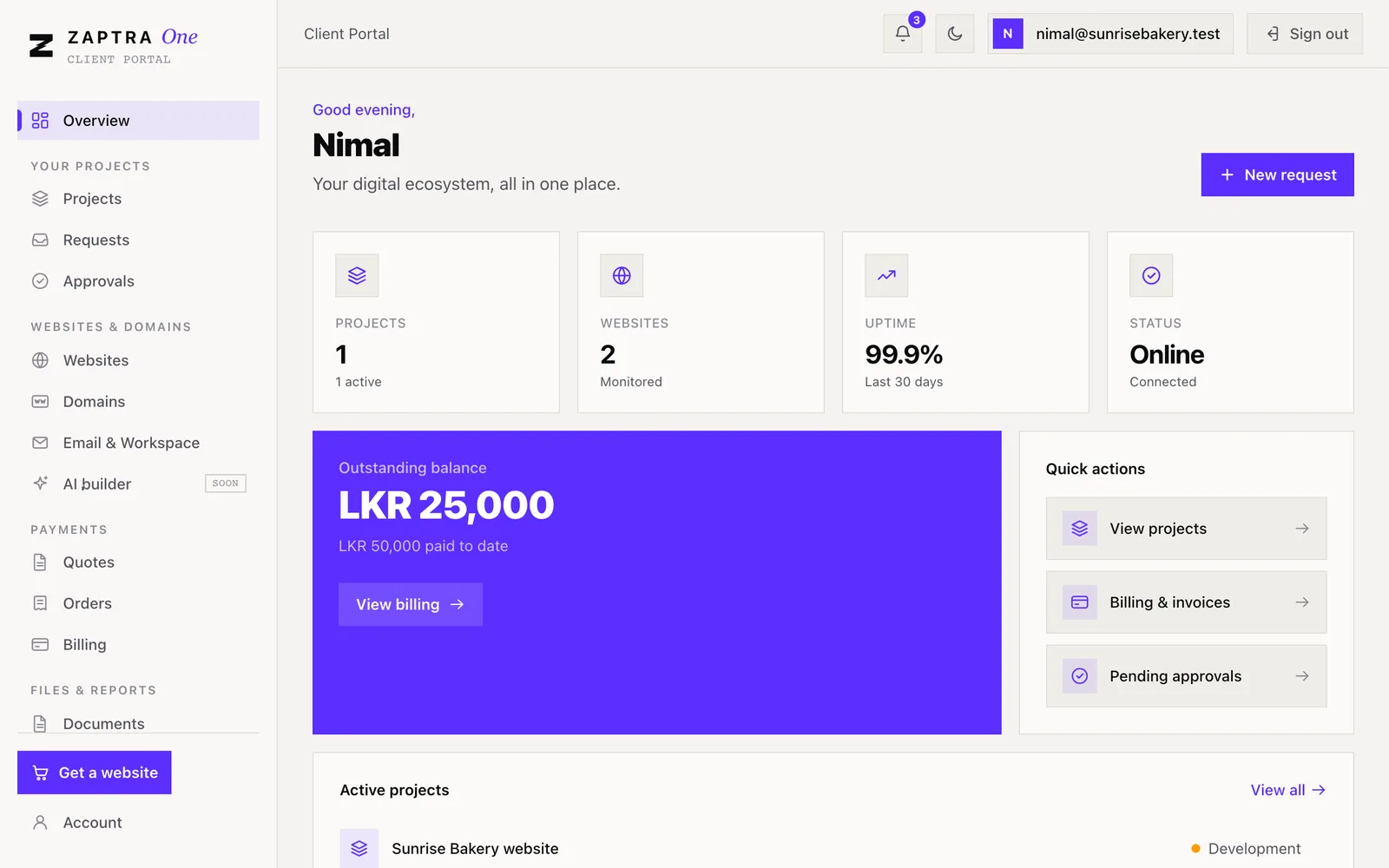
Zaptra’s clients used to find out how their website was going by asking. We built one login where a business sees every project, approval, invoice, domain and website Zaptra runs for it — and an admin where Zaptra runs the whole relationship. Portal, admin, API, emails, monitoring, help centre and films.
How we work
Five stages, and each one grows out of the last.
We start where the friction is: the WhatsApp thread, the spreadsheet, the bank slip nobody can find. Requirements come from the work, not a template.
Every product gets a numbered spec of what it is and a decisions log of why. New engineers — and AI agents — can pick it up from one page.
Data model and tenancy first, screens second. A clean domain model is what lets a product grow for years without a rewrite.
Integration tests against a real database gate every deploy. A merge to main is a production release, so main is always releasable.
We run what we build — backups, monitoring, incidents — and we ship the help centre, the films and the study alongside the code.
The group
Labs sits in the middle: it builds what the others sell, run and grow. Zaptra One is the clearest example — Zaptra owns it, Labs builds it, TechZap Infra connects it to the outside world.
Enterprise software, engineering and consulting for clients.
Brands, websites and growth for businesses — and the owner of Zaptra One.
Builds and maintains the group’s products and platforms.
Fronts every provider the group relies on: domains, email, SMS, storage, AI.
Business automation, designed and run for you.
Agents and copilots for serious business systems.
Lab notes
Postgres, containers, a reverse proxy. Proven parts, so the novelty goes where customers can feel it.
Every change is a versioned migration. Balances are derived from the ledger, never stored and hoped for.
Scoping is enforced centrally on every read and write. Another organisation’s data is a 404 — it simply does not exist.
If a human still has to click, it shows up in a queue with an owner and an SLA. That queue is our automation backlog.
Help articles, videos and decision records are part of done. Software nobody can explain is not finished.
We write studies of what we build — the problem, the trade-offs, the parts that are not finished yet.
Partner with Labs
We take on a small number of partnerships each year — operators with a hard, recurring problem and the appetite to build something that lasts.
Start a conversation